MATERIAL LIVES OF COLOUR, FROM HERITAGE TO INNOVATION
With: With: Anahí Re (University of Buenos Aires), Lara Martínez (University of Buenos Aires), & Francisco Guichón (National Scientific and Technical Research Council, Argentina); Silvia Vignolini (Director of the Max Planck Institute of Colloids and Interfaces); and Riikka Räisänen (University of Helsinki)
Friday July 17, 2026, 10:00 am - 11:30 pm, US Eastern Time
Part 2 of Series: Colour in Practice: Expanding Knowledge for a Changing World
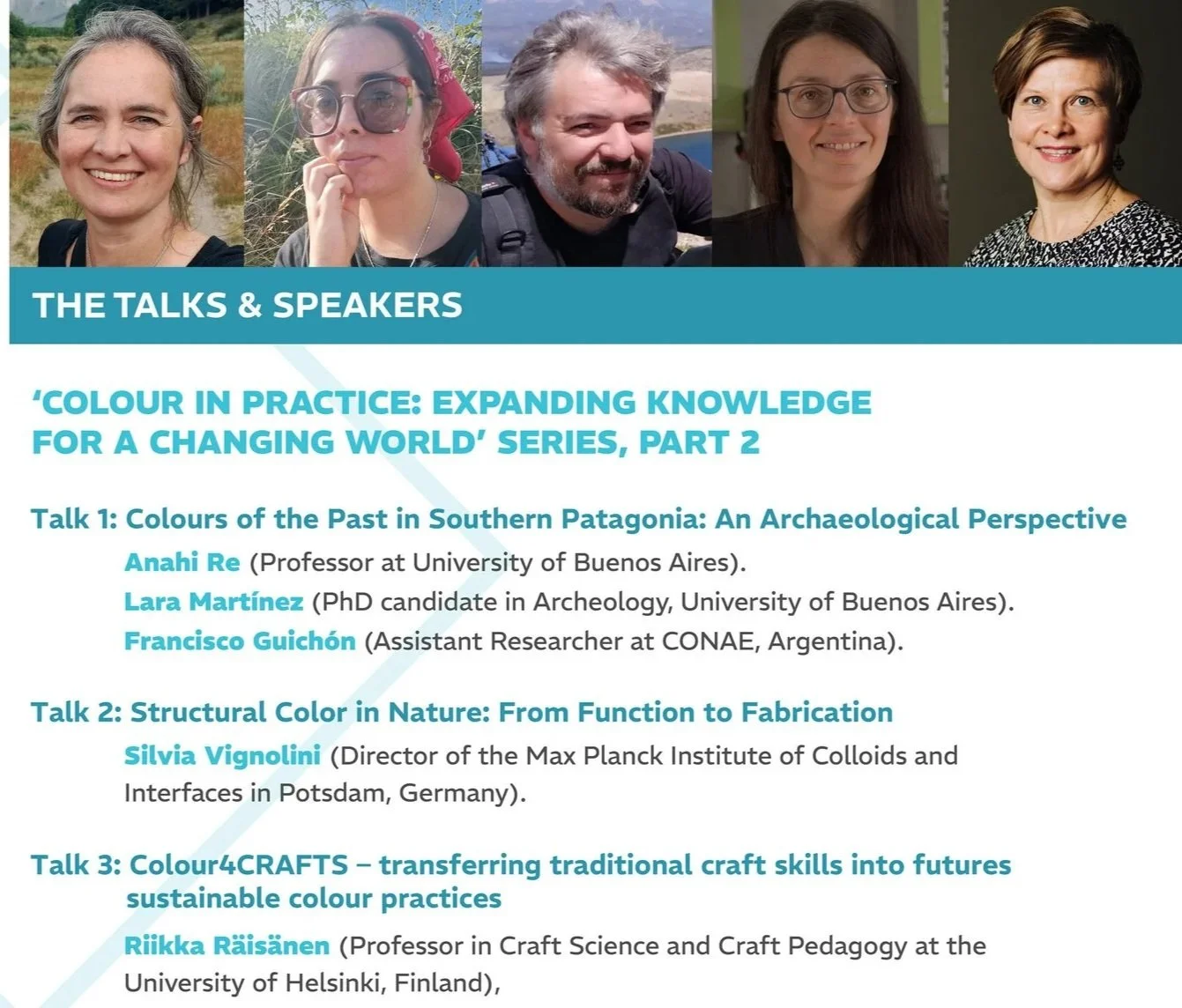
Anahí Re (University of Buenos Aires), Lara Martínez (University of Buenos Aires), & Francisco Guichón (National Scientific and Technical Research Council, Argentina)
COLOURS OF THE PAST IN SOUTHERN PATAGONIA: AN ARCHAEOLOGICAL PERSPECTIVE
Colour plays a key role in communication both in the present and in the past. As archaeologists we are interested in understanding information exchange over several millennia. In this context our research undertakes the study of different materials that showcase how colours were produced, applied, and used. In this presentation we summarize our findings and initial conclusions in our study region, located in southern Patagonia (southernmost South America), where different hunter-gatherer groups lived from 10,000 years ago until the 20th century. We have identified potential sources of coloring raw materials using remote sensing, as well as different materials involved in the production and application of paints, such as numerous grinding stones. Regarding their uses, archaeological evidence indicates their importance in the manufacture of rock art paintings and on portable items. These materials constituted an important source of information for past populations living in a climatically and socially changing environment. Nonetheless, paints also had other uses. Historic accounts written between the 16th and 20th centuries point to the application of colouring substances on perishable surfaces such as leather which have not been preserved. The characterization of these archaeological materials, including the application of physicochemical techniques and experimentation, allowed us to define a colour palette for the study region. Overall, this research provides new insights into the role of colour in past hunter-gatherer societies and contributes to a better understanding of the material ways in which information, identities, and meanings were communicated across the Patagonian landscape during the last 10,000 years.
Anahí Re has a PhD in Archaeology from the University of Buenos Aires (UBA). She is currently a Professor at the UBA and an Independent Researcher at the National Scientific and Technical Research Council (CONICET), based at the National Institute of Anthropology and Latin American Thought (INAPL). Her research focuses on rock art and different portable items in the context of communication networks and social interactions between human groups on different spatial and temporal scales. She has worked in different regions of Argentina. Nowadays she studies past human groups, mainly hunter-gatherers, who lived at central-western Santa Cruz (southern Patagonia).
Lara Martínez has a degree in Anthropology from the National University of La Plata (UNLP) (Argentina). She is currently pursuing a PhD in Archaeology at the University of Buenos Aires (UBA) and has a doctoral scholarship from the National Scientific and Technical Research Council (CONICET), based at National Institute of Anthropology and Latin American Thought (INAPL). Her research encompasses the role of colour as a part of past hunter-gatherer communication strategies in southern Patagonia. She studies rock art images and different kinds of archaeological materials related to the production of paints. She includes physicochemical analysis for their study.
Francisco Guichón has a PhD in Archaeology from the University of Buenos Aires (UBA). He is currently an Assistant Researcher at the National Scientific and Technical Research Council (CONICET), based at the National Space Activities Commission (CONAE). He studies rock art, hunter-gatherer communication networks and past land use in southern Patagonia. Over the last several years, his work has incorporated Geographic Information Systems (GIS), remote sensing and satellite imagery analysis for archaeological research and cultural heritage management.
Silvia Vignolini (Director of the Max Planck Institute of Colloids and Interfaces)
STRUCTURAL COLOR IN NATURE: FROM FUNCTION TO FABRICATION
Structural color arises not from pigments but from the interaction of light with nanoscale architectures, producing some of the most vivid and dynamic hues found in the natural world. In this talk, Silvia will introduce the concept of structural color and illustrate the remarkable diversity of functions it serves across living organisms, ranging from interspecies communication and signaling to camouflage and concealment. She will then examine the nanostructures responsible for generating these colors, exploring how their geometry and organization give rise to specific optical effects. Finally, Silvia will present recent insights into how we can mimic these elegant natural designs to engineer new materials and technologies for coloration.
Prof. Silvia Vignolini graduated in Physics from the University of Florence, Italy. From 2009 she was a postdoctoral researcher at both the University of Florence and the University of Cambridge. In 2013, she became a Lecturer in Physics at University College London and then a Lecturer in Chemistry at the University of Cambridge from 2013 to 2017. At the University of Cambridge, Silvia made important contributions to the fields of chemistry and biomaterials. She was University Lecturer in Chemistry and Biomaterials from 2017 to 2020, then Professor of Biomaterials and Sustainability from 2020 to 2022. Since January 2023, she has been Director of the Max Planck Institute of Colloids and Interfaces in Potsdam. In this role, she heads the newly established department of “Sustainable and Bio-inspired Materials”, where she aims to research and develop materials with predominantly optical functions modelled on nature.
Riikka Räisänen (University of Helsinki)
COLOUR4CRAFTS – TRANSFERRING TRADITIONAL CRAFT SKILLS INTO FUTURES SUSTAINABLE COLOUR PRACTICES
Colour4CRAFTS was a 3-year project (ended in June 2026, funded by the EU- Horizon). It combined a multidisciplinary team of experts from five research institutes and a R&D company to carry out studies of traditional historic colouration practices combined with technologies of colourants biosynthesis and waterless applications techniques. Further, Colour4CRAFTS created futures visions for the textile colouration in Europe and highlighted the importance of crafts for the European economy. The researchers in the project presented archaeology and history, textiles technology and colouration, biotechnology and chemistry, art, craft and education. This created a manifold basis to understand colouration practices in history, craft and industry context profoundly and propose innovative solutions for the futures’ colouration practices. Education and communication had important roles in the project: the project organized several exhibitions, seminars and workshops as well as educational settings for public, professional and scientific audiences. Research aimed to foster European cultural heritage and the European cultural and creative industries, craft skills in textile colouration, and transformation of traditional processes into sustainable ones, which support futures’ green deal objectives. With other EU funded projects from the same creative industries cluster (i.e., CRAFTOUR), Colour4CRAFTS created and presented policy recommendations for the European Parliament for the support of European craft.
Riikka Räisänen, PhD, is a professor in craft science and craft pedagogy at the University of Helsinki, Finland. She has background in natural sciences, i.e. chemistry, physics and environmental studies, textile technology, craft research and education. Her research interests are in natural and bio-based colourants, sustainable textiles, as well as craft culture and textile heritage. She has lead several research projects on bio-based colourants and bioactive compounds, such as Strategic Research Council (at the Research Council of Finland) funded BioColour (https://biocolour.fi), EU-Horizon funded Colour4CRAFTS (https://colour4crafts.eu/) and Jane & Aatos Erkko Foundation funded BioAnti. In 2016 she was awarded with the silver medal of the Society of Dyers and Colourists UK for the work within natural colourants, and in 2022 with the bronze medal of the International Horticultural Society. She has actively published in scientific and popular forums, as articles, lectures and exhibitions.