Colour Literacy Cornerstones
The Colour Literacy Project is built around four foundational Cornerstones.
-Experiencing Colours
-Perceiving Colours
-Describing Colours
-Working with Colours
Colour is one of the most immediate and universal aspects of human experience, yet it remains surprisingly underexplored as a subject of sustained, structured learning. Rather than belonging to any single discipline, these Cornerstones are designed to support and connect learning across the sciences, the arts, and the humanities.
Working together, the Cornerstones provide a coherent, expansive framework for colour education.
All the exercises on our website are organized under the Cornerstones. Each exercise is designed to encourage educators and their students to personally engage with colour as a rich and rewarding field of exploration.
At the heart of the Colour Literacy Project is a belief that colour is best understood through doing. The Project's lessons and activities are carefully scaffolded, building knowledge and confidence step by step through hands-on exploration — observing, comparing, discussing, and making. This approach reflects a conviction that the many ways colour shapes our perception, our emotions, our environments, and our communication are not best grasped through theory alone, but through direct, guided encounter.
When we engage with colour actively and reflectively, we begin to see the world around us with new eyes.


Colour is something we live with everyday and take for granted.
This Cornerstone invites learners to slow down and pay fresh attention to colour as a felt, embodied encounter and noticing how it shifts with light, context, and time.
By grounding colour education in personal experience of the important roles colour plays in our lives, we build a foundation that is rich and genuinely shared across disciplines.


Colour doesn't exist in the world alone — it is co-created by light, matter, and the human visual system.
This Cornerstone explores how we actually see colour: the biology of the eye, the role of the brain, and the ways perception varies between individuals and cultures.
Understanding perception helps us recognise that colour is never neutral, and that seeing is always an active, interpretive act.

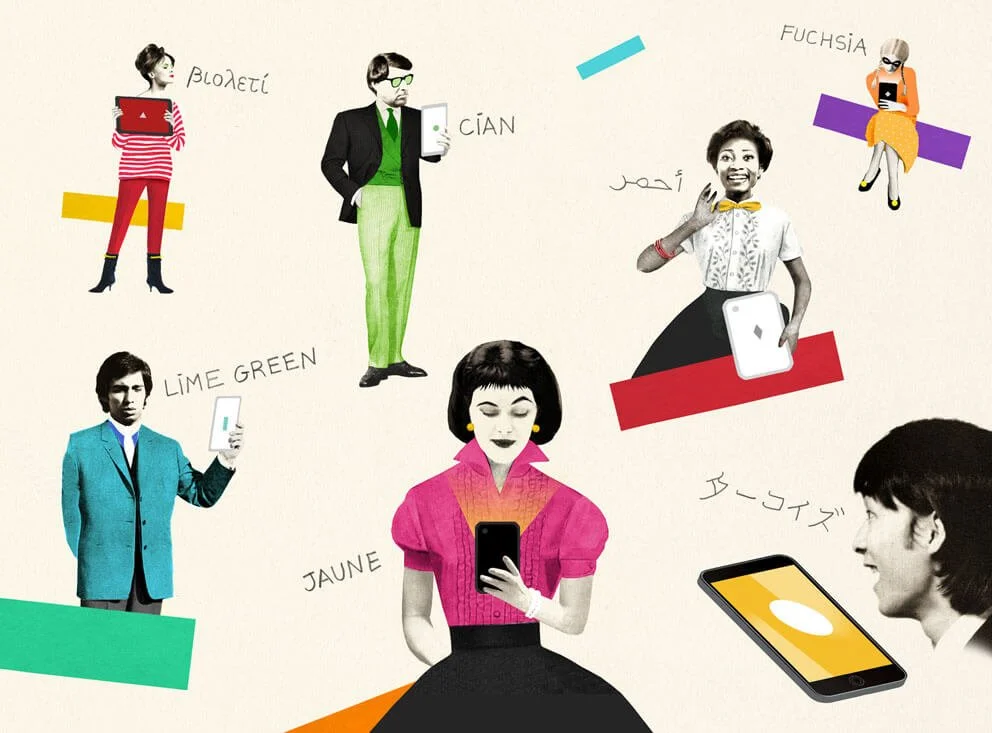
To talk about colour well is a skill — and a surprisingly rare one.
This Cornerstone develops the language, systems, and frameworks that allow learners to communicate about colour with clarity and confidence.
Drawing on traditions from art, science, and the humanities, the basic terms used to describe colour are expanded from a two dimensional colour circle into three dimensional colour models.


Colour knowledge only comes fully alive when put into practice.
This Cornerstone connects understanding to making — exploring how colour functions in materials, media, and the designed and natural world.
Hands-on exercises encourage learners to experiment, reflect, and develop an informed, flexible approach to colour that supports the both the creative and the analytical use of colour.